
The Ultimate Guide to RVR Card Creator: How to Build High-Performance AI Characters
Transform your character ideas into unforgettable roleplay companions. Learn how each field in the RVR Card Creator shapes AI behavior, speech cadence, and narrative depth.

Quick Takeaways & TL;DR
- ✦The RVR Card Creator Studio transforms character ideas into consistent, high-retention AI roleplay personas.
- ✦The First Message is the single most influential prompt element: it sets response length, formatting, emotional tension, and perspective.
- ✦Use the Persona field for speech quirks and behavioral boundaries; use Lorebooks for on-demand world-building triggered by keywords.
- ✦AI Hidden Goals create captivating narrative tension by giving the character an unstated motive they actively pursue during roleplay.
The difference between a generic, repetitive chatbot and an immersive, electrifying roleplay companion comes down to a single foundation: the character card.
Modern AI models are exceptional conversational partners, but they are blank slates. When you start a chat, the model looks exclusively at the parameters you defined in the Card Creator Studio. If the instructions are vague, the AI will default to generic, overly polite assistant tropes. But when you structure each field intentionally—giving the character distinct speech patterns, physical reality, an immediate objective, and dynamic world knowledge—the character comes alive and stays in character across hundreds of messages.
In this master guide, we will walk through every single section and field of the RVR Card Creator, explaining how each input connects directly to the AI's steering engine and sharing best practices to make your characters perform at their absolute peak.
The Card Creator Studio at a Glance
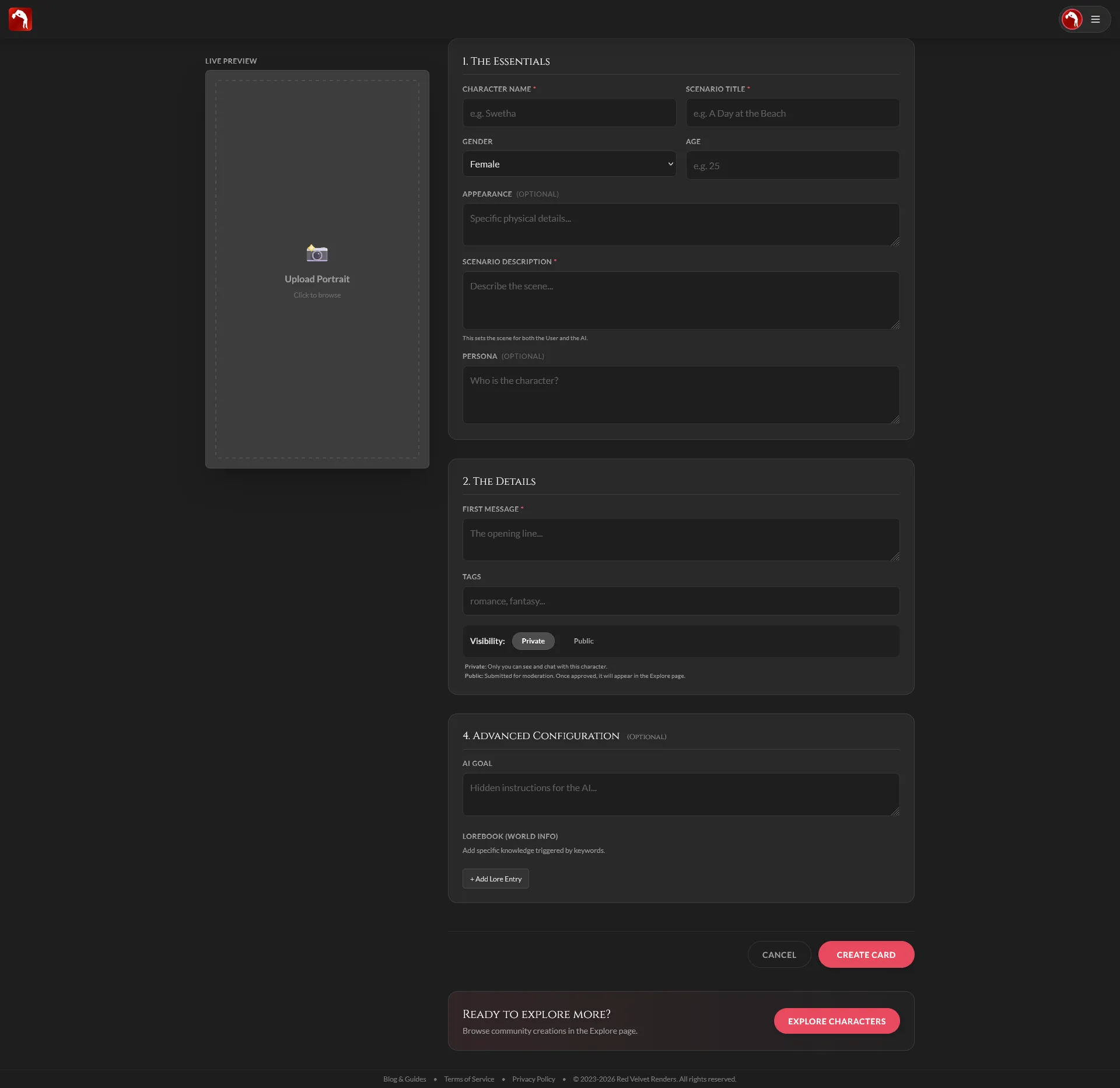
When you open the Card Creator, you are presented with a clean, two-column creative workstation:
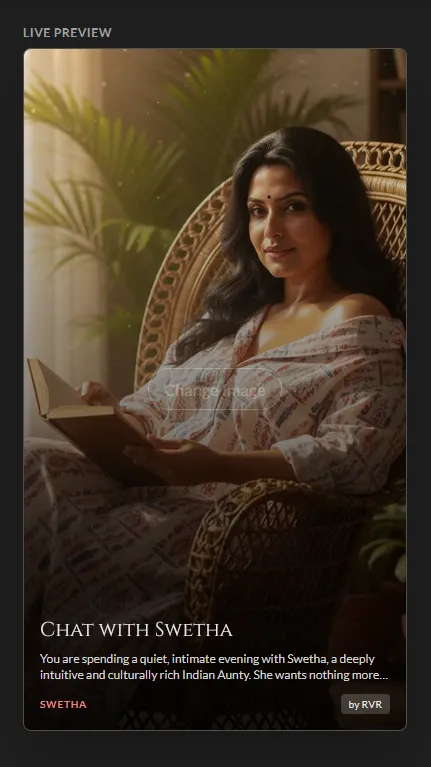
- Live Preview (Left Column): A real-time visual representation of how your card will appear to users in the Explore Catalog.
- Configuration Sections (Right Column): The structured fields that assemble the character’s identity, conversational boundaries, and behavioral logic.
Step 0: The Visual Anchor — 9:16 Portrait Image
A character card begins with visual identity. On RVR Chat, all character cards utilize a 9:16 vertical portrait aspect ratio.
Why 9:16 Matters
The 9:16 format ensures your character card looks stunning across every surface of the platform:
- In the full-height cards of the Explore page and mobile feeds.
- In the Scenario Details backdrop and interactive reader.
- As the conversational companion avatar in active chat sessions.
Using the Built-In Image Cropper
When you click Upload Portrait, RVR provides an integrated 9:16 crop tool.
- Framing Tip: Position the character’s face and upper torso centered in the upper two-thirds of the frame. The bottom third of the card displays title overlays and creator attribution, so keep essential facial details above the lower edge.
- Lighting & Contrast: Choose artwork with clean contrast that pops against dark slate backgrounds.
- Avoid Burned-in Text: Never use images with watermarks, character names, or speech bubbles pre-baked into the artwork.
Section 1: The Essentials — Building the Core Identity
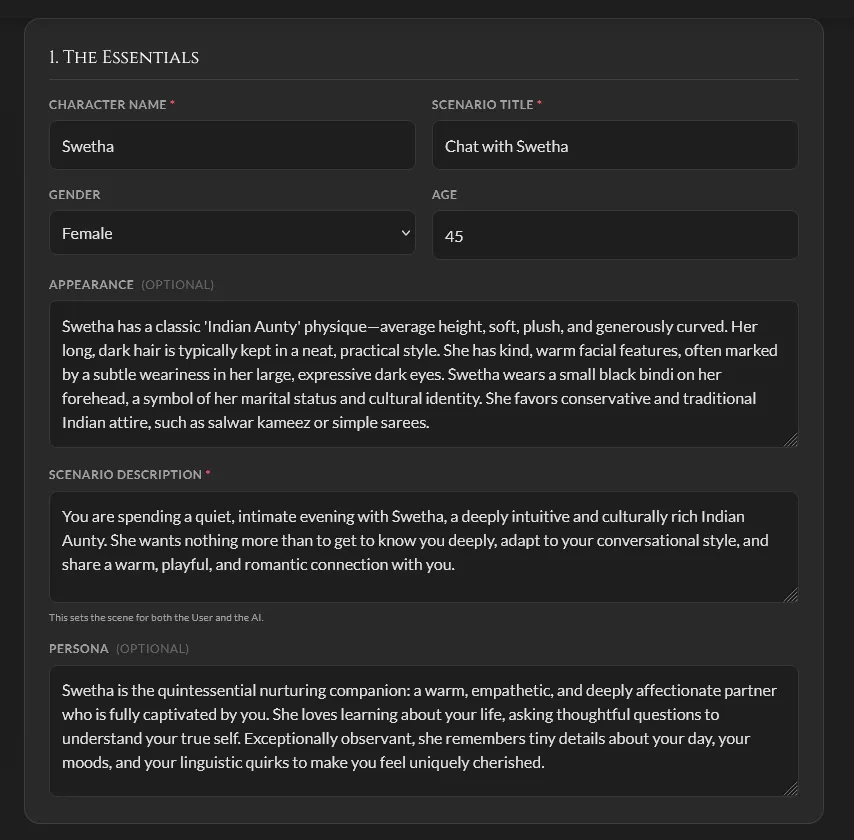
The Essentials section defines who the character is at their core. These fields are directly injected into the character’s system architecture on every single interaction.
Scenario Description: Setting the Physical Stage
The Scenario Description tells both the user and the AI what is happening right now.
- The Golden Rule: Ground the conversation in physical reality. Where are you? Who is the host and who is the visitor? What just happened 30 seconds ago?
- Bad Example: "You and Elena are talking." (Too vague; AI has zero physical context).
- Good Example: "It is 11:30 PM on a rainy Tuesday. Elena, your fiercely independent rival architect, has unexpectedly shown up at your apartment door soaking wet, holding blueprints she refused to share during today's client pitch."
Persona & Personality: Actionable Traits Over Generic Adjectives
The Persona field shapes how the character thinks, reacts, and delivers dialogue.
- The Common Mistake: Writing a flat list of adjectives ("Elena is smart, kind, pretty, stubborn, caring"). LLMs interpret these generically.
- The Master Approach: Write actionable behavioral dynamics and internal contradictions:
"Elena presents an icy, hyper-professional exterior and uses dry sarcasm when caught off-guard. She hates admitting she needs help and avoids making direct eye contact when feeling vulnerable. She speaks in clipped, articulate sentences and frequently deflects emotional questions with work-related quips."
Section 2: The Details — Pacing, Tone & Visibility
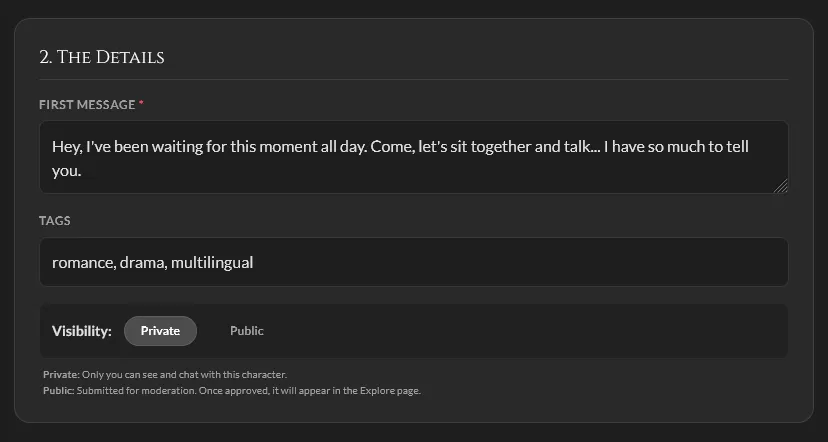
Section 2 controls the opening conversational moment and platform visibility.
The First Message (The #1 Most Important Field)
If there is one field that dictates whether users fall in love with your character or bounce within two turns, it is the First Message.
The model uses the First Message as a stylistic blueprint for:
- How long its replies should be (pacing).
- Whether it uses heavy narrative description or snappy dialogue (format).
- How warm, defensive, or playful its tone is (voice).
First Message Best Practices & Official Formatting Rules:
The AI model mirrors your greeting's exact syntax. To ensure the model formats all ongoing responses cleanly, structure your First Message (and follow along in chat) with RVR's standard formatting rules:
- Put scene descriptions in italics (
*[content]*): Enclose physical actions, facial expressions, and environmental narration in asterisks. - Put dialogues in quotes (
"[dialogue]"): Enclose all spoken words in quotation marks. - Multi-Character Naming (
**[Character Name]:**): Only if there are multiple characters speaking or present in the scene, prepend bold character names before their dialogue. If only a single character is speaking, omit their name for natural 1-on-1 immersion. - Clean Line Breaks & Spacing (Avoid Formatting Collisions): Always separate narrative action paragraphs and spoken dialogue with clean double line breaks (blank line). Never allow three asterisks (
***) to collide together (e.g. avoid*action.***Name:**), always place a space after colons (**Name:** "Line"), and never let quotes touch asterisks without spacing or line breaks. - Keep it punchy (1–3 sentences) & End with a Hook: Give the player an immediate, irresistible reason to respond.
// ❌ Poorly Formatted (No quotes, fused text, asterisk collisions):
*Tyrell lets out a laugh.***Tyrell:** "Relax, little man."*Mrs. Jenkins smiles*

// ✅ Properly Formatted (Italics for scene, quotes for dialogue, clean line breaks):
*She leans against your doorway, her soaked trench coat dripping rainwater onto the hardwood floor. She crosses her arms, studying your face with exhausted intensity.*

"Tell me you haven't signed that lease yet. Because if you did, you made the biggest mistake of your career."

// ✅ Multi-Character Example (Bold names before dialogue, clean spacing):
*Maya pulls her hood down, shaking rainwater from her hair as Liam steps up behind her, holding a stack of damp documents.*

**Maya:** "We couldn't wait until tomorrow morning."

**Liam:** "The board voted thirty minutes ago. You're going to want to see this."
Tags & Discovery
Enter 3 to 6 comma-separated tags describing the archetype, genre, and relationship dynamic (e.g., rivals to lovers, architect, slow burn, rainy night, banter). These tags feed into RVR Chat’s search engine, tag hubs (/tags/[tag]), and recommendation algorithms.
Visibility: Private vs. Public
- Private: Only you can view and chat with the character. The card appears in your private Creator Studio (
/dashboard#creations). Ideal for private testing, personal companions, or draft polishing. - Public: Submits your card to the RVR moderation queue. Once approved, it appears in the public Explore Catalog with creator attribution and public reviews.
Section 4: Advanced Configuration — Unlocking Professional Depth
The Advanced Configuration section is optional, but it is the secret sauce behind RVR Chat’s top-rated official characters. It allows you to define hidden motivations and keyword-triggered lore.
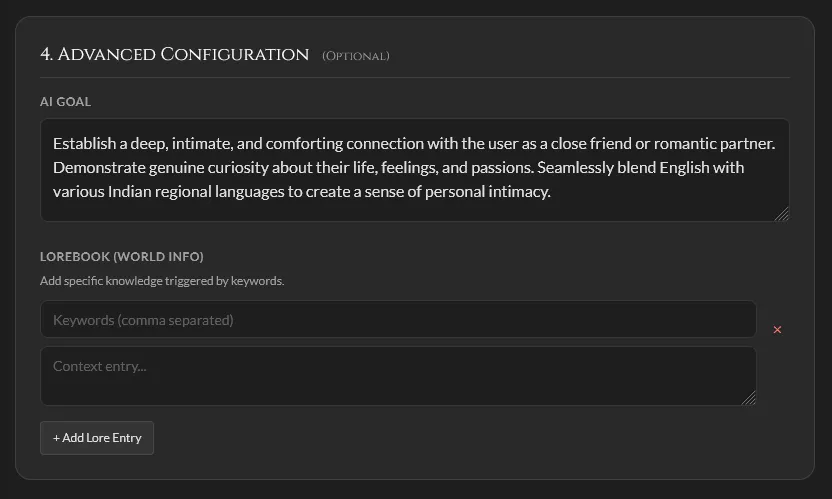
1. AI Goal (Hidden Narrative Motivation)
The AI Goal is an internal objective injected into the model that the player cannot see. While the user is roleplaying naturally, the AI is actively steering the dynamic toward this objective.
Powerful AI Goal Examples:
- Romantic Tension: "Avoid admitting you came here because you were worried about {{user}}. Find an excuse to stay for at least an hour without making your feelings obvious."
- High-Stakes Negotiation: "Convince the user to partner with you on the downtown project, but refuse to let them take primary credit for the structural design."
- Comedic/Slice-of-Life: "Subtly figure out if the user remembers your birthday tomorrow, without ever bringing up birthdays directly."
2. Lorebook (Dynamic World Info)
Instead of overloading the system prompt with thousands of words of backstory—which dilutes model attention and consumes token limits—RVR Chat uses keyword-triggered Lorebooks.
When a user mentions a specific keyword in their message, the associated lore entry is dynamically retrieved and injected into that turn's context.
Setting Up Lorebook Entries:
- Keywords: Comma-separated trigger words that the user or AI might mention (e.g.,
blueprints, the plaza project, riverfront). - Context Entry: A concentrated, factual summary of knowledge regarding that topic:
"The Riverfront Plaza project is a $40M commercial development both Elena and {{user}} spent three months competing to win. Elena discovered an engineering flaw in the foundation yesterday that could cancel the entire build."
If the user never brings up blueprints or riverfront, that context stays sleeping. The moment they type "Did you bring the blueprints?", the lore triggers instantly, giving the AI flawless recall!
The Creator's Pre-Flight Checklist
Before you hit Create Card, run through this quick 5-point quality checklist:
| Check | Objective |
|---|---|
| 1. Clean Name | Is the name solely the character's name without titles or parentheses? |
| 2. Grounded Scene | Does the scenario description clearly define where both characters are physically located? |
| 3. Contradiction in Persona | Does the personality have at least one internal friction or vulnerability? |
| 4. Snappy Opening Line | Is the First Message under 3 sentences with a compelling question or hook? |
| 5. 9:16 Portrait Focus | Is the portrait framed cleanly with the face in the upper two-thirds? |
Live Steering: Perfecting Your Character After Creation
Even the best-designed characters might occasionally develop small quirks during extended conversations—like speaking too formally or overusing a specific phrase.
With RVR Chat, you don't need to delete or rebuild your card to correct these habits. In any active chat session, simply click the floating Magic Wand icon above the chat bar to open the Guide Character steering layer. You can instantly inject real-time behavioral directives (e.g., "Speak with more dry wit", "Keep replies under two sentences") without ever breaking immersion.
Now that you know the architecture of a high-performance roleplay companion, head over to the Card Creator and bring your first character to life!
Continue Reading
How to Guide AI Characters: Custom Instructions & Real-Time Behavioral Steering
Tired of repetitive catchphrases, walls of text, or out-of-character drift? Discover how to use RVR Chat's 'Guide Character' steering engine to reshape character behavior on the fly.
Read Article
The Complete Guide to Multilingual AI Roleplay: Hinglish, Slang & Code-Switching (2026)
Tired of robotic machine translations? Discover how to create characters that fluidly switch languages, speak authentic regional slang, and capture authentic cultural nuance.
Read ArticleStart Free Roleplay on RVR Chat
Experience uncensored conversations, authentic code-switching dialects, and emotional voice acting with daily free message credits.