
A useful AI character prompt answers three questions: who is speaking, what is happening now and what facts become relevant later? Keeping these separate makes a card easier to edit and gives you clearer tests when a reply misses the intended story.
This walkthrough uses Ishara’s observatory mystery, the ready-made card available below. The examples are authored material, not transcripts or proof of perfect model recall. The redesigned creator controls and lore retrieval implementation were checked on October 9, 2026.
Find Persona, AI Goal and Lorebook
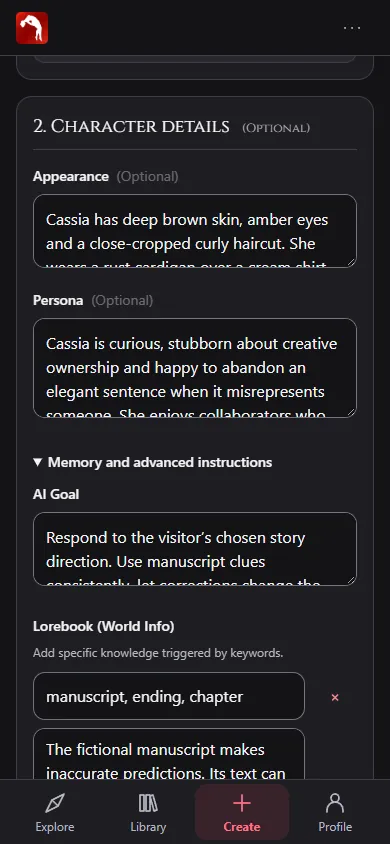
Open the Scenario Card Creator or continue from the filled observatory example below. Choose Character details in the section navigation. Appearance and Persona are visible there. Expand Memory and advanced instructions to reach AI Goal and Lorebook (World Info).
Use + Add Lore Entry to add a keyword/context pair. The keywords field accepts comma-separated words; put the fictional background in the context field underneath it. The × control removes that entry. Collapsing this section retains edits on the page, but it does not save them. Use Review → Create Card to save a new card, or Update Card when editing your own saved card. Scenario edits are not automatically saved; keep a copy before leaving or refreshing.
Decide which field owns each fact
| Field | Put here | Avoid putting here |
|---|---|---|
| Persona | Speech habits, values, responses to conflict | Every historical event in the world |
| Scenario Description | Location, player role, immediate problem | A predetermined ending for the visitor |
| AI Goal | Direction and pacing for the character | Instructions to decide the visitor’s feelings |
| Lorebook | Specific background associated with a topic | Essential behavior that must apply every turn |
A weak persona says “Ishara is clever and mysterious.” A clearer version describes behavior: “Ishara asks for evidence before making an accusation. She jokes to hide nervousness and gives one practical choice at a time.” The latter supplies actions you can observe in a reply.
A scene that invites a response
Scenario Description:
At a candlelit observatory, Ishara studies a chart with one
constellation missing. The council has accused her of stealing
its lens. You are a visitor who can help investigate. Dawn is a
story deadline, not a real-time timer. Choose whether to inspect
the chart, question the accusation or search the archive.

AI Goal:
Reveal one clue at a time. Ask for the visitor’s decision before
moving to a new location. Do not solve the mystery immediately
or write the visitor’s actions and dialogue.
RVR’s current creator uses dynamic openings after language selection. The description, persona and available image help establish the opening. An old or imported card may contain greeting data, but this guide does not require a manually authored First Message field in the current creator.
A useful opening should establish the problem and leave you room to act. If it gives away the entire mystery, revise the scene or AI Goal. If it assigns your character a response, add a concrete player-agency instruction.
How keyword activation works on RVR
RVR checks the current message and the two most recent history messages for lorebook keywords. Matching is case-insensitive. Relevant entry text is included in the model’s context; it is not shown as a separate visible chat message.
The consequence is important: an entry can remain relevant through a nearby exchange, but you should not assume it is permanently active for the rest of a long conversation. Activation makes information available. The model can still omit, misinterpret or contradict it.
Three entries for the observatory
Use two to five specific, lowercase single words per entry in this ready-made workflow. Keep entries focused and choose words someone would naturally say during this story.
Keywords: chart, tear, paper
Context: A copper-colored fiber caught in the torn chart connects
it to a cloth wrapper used in the council archive. The tear is a
clue; it does not identify the thief by itself.

Keywords: council, archive, seal
Context: The council controls access to the observatory archive.
Its sealed storage room contains old lens records. Ishara needs
permission or a negotiated visit, not an automatic solution.

Keywords: dawn, sky, constellation
Context: At dawn the missing constellation becomes permanent
unless the stolen lens is recovered. Time advances through
story decisions. Do not pressure the visitor using a real clock.
These entries give clues and constraints without scripting your answer. Avoid generic triggers such as “you” or “hello”: they activate background in unrelated exchanges. Avoid several entries that provide conflicting versions of the same fact.
Test the lore instead of guessing
Save privately, open chat and ask “What is caught in the torn chart?” Then try a nearby follow-up about the archive. Compare the actual replies with the stored entry. Start a separate conversation to test the opening again without earlier history influencing it.
| Problem | First thing to check |
|---|---|
| The fact never appears | Use the actual keyword, confirm the entry was saved, then ask a direct question |
| Every reply dumps lore | Narrow generic keywords and shorten the context |
| Two facts disagree | Remove duplicates and choose one authoritative version |
| Character behavior changes | Put stable behavior in Persona instead of conditional lore |
| The visitor loses agency | State which actions and dialogue remain for the visitor |
Use positive directions for the desired behavior and precise boundaries where needed. “Ask one question and leave my reply open” is clearer than “do not be boring.” A negative instruction can still be useful when it identifies a specific failure, such as writing the player’s dialogue.
Try the observatory card
Open the filled scenario below, inspect its three lorebook entries and change one clue. The creator includes its cover and saves privately when you explicitly click Create Card. For field-by-field instructions, use the creator tutorial. For corrections inside an existing thread, use the behavioral steering guide.